Category: Intelligent Communities

  • Congratulating Stratford and Windsor-Essex for making the list of the Top Seven Intelligent Communities of the year

    This week, I was pleased to be part of the following exciting announcement:
    i-Canada Alliance

    Ottawa, January 24, 2011 – i-Canada Chairman Bill Hutchison has sent his congratulations to officials in two Canadian cities — Stratford and Windsor-Essex — on their achievement of making the list as one of the Top Seven Intelligent Communities of the year.

    “To have two Canadian cities among the Top Seven in this competition says a lot about Canada’s capabilities and potential,” said i-Canada Chair Bill Hutchison. i-Canada is a program driven by grass roots business, civic and academic leaders, dedicated to raising Canada to “i-Nation” status through the development of intelligent communities across the country. The world’s leading i-Nations consistently have high rankings in innovation, productivity, job creation, and social prosperity.

    Read the complete announcement here on the CATA Alliance Web site.

  • i-Canada and Public Ultra Broadband

    The vision for i-Canada is a nation of provincial and local Intelligent Communities large and small, urban and remote featuring great places to live with innovation cultures and communications infrastructures that ensure economic growth, satisfying employment and social prosperity. Last month in New York, Shawn Graham, the Premier of New Brunswick became the first Canadian to receive the Visionary of the Year award from the Intelligent Community Forum, a global think tank that annually selects the Intelligent Community of the Year. He received the award for his vision and support in moving New Brunswick and its communities to new levels of collaboration and innovation built on a foundation of new communications infrastructures. Premier Graham is supporting i-Canada as are mayors and a core group of hundreds of Canadian citizens and business leaders.

    In the future i-Canada’s Intelligent Communities will have blended our traditional values with the best new applications of 21st century digital technology to create new models for effective health care, aging well and world class education and learning. Our companies, large and small, will be able to innovate and compete with the best in the world because they have the ability to collaborate together to establish 21st century clusters of innovation. The foundation for this collaboration will be provided by open access ultra broadband telecommunications networks, mobile and fixed, that compete with the best in the world on price and performance. 21st century digital collaboration will be required to compete with the best in the world by enhancing our business innovation clusters and creating new ones that build on our research initiatives and commercialize them quickly.

    Great cities don’t run on gravel roads.
    The great industrial clusters of the 20th century grew because of their Collaboration Ecosystem® and we only need to observe today’s younger generation of millennials to know that collaboration is moving to a new space … a space defined by the Internet and characterized by social networking and telepresence systems.

    The challenge for Canada is that we have fallen well behind with our public communications networks and infrastructure. Great cities do not run on gravel roads and for the most part, Canadian public broadband is the equivalent of gravel roads in terms of performance and price as evidenced by the fact that Canada has been ranked 22nd out of thirty countries studied by the independent Berkman Center for the Internet and Society at Harvard. Other independent studies have supported the Berkman results and confirmed Canada’s seriously declining world ranking in price and performance of our public broadband communications.

    Major cities of the world already provide their residents with 100 million bytes per second, mb/sec of broadband performance (ultra broadband) for around $40 per month, similar to our price for just two to five million bits per second, a Canadian disadvantage of 20 to 50 to one. And a few leading international communities are already talking about one billion bits per second to the home: 1 gigabit per second, (1gb/s). Two months ago Google announced they would work with ten 50,000 person communities in the US to create a public broadband infrastructure of one gigabit per second each: another sign of the times.

    Why is low cost Ultra broadband important?
    California’s Silicon Valley rose to become one of the world’s great innovation hubs because of its Collaboration Ecosystem®. In the 1960’s other regions like Boston’s “Route 128” had great universities, large anchor companies and plenty of financial institutions but within twenty years Silicon Valley had outstripped Route 128 and all others to become the world’s leading global hub of innovation. Collaboration within the community was the reason for its success and today, collaboration is still at the heart of successful innovation whether it is within a company, within a community, region, country or globally.

    Twenty years ago we laid the foundation for national and regional collaboration within Canada’s research and education community when we created the provincial regional research networks and connected them across Canada with a national network, CA*Net, supported by CANARIE, the Canadian Network for the Advancement of Research, Industry. I was honoured to be the founding Chair of CANARIE and over the past twenty years, ORION and BCNet along with our other regional networks and CANARIE have become recognized as world leaders in the Research and Education Network ,” REN”, community. Collaboration has flourished in these communities compared to the days when it was extremely difficult for researchers at UBC to collaborate with those at McGill and others located thousands of kilometers apart.

    But why is it that for the past twenty years we have left our public citizens and companies “out in the cold”, lacking the same ability to collaborate at the same high speed and low cost? Why do they not have the same virtual collaboration facilities that have been available to our research and education community?

    Around the world we have seen rapid company formation and growth in communities that have open access ultra broadband available at for the same cost that our public pays for slow broadband on closed access systems. It is time for change and i-Canada will promote and support the move to world class public open access ultra broadband networks to allow all communities the same innovation and public services advantages now being enjoying in leading communities around the world.

    We’ve got a lively discussion going on LinkedIn, and would love to have you join and weigh in with your thoughts and perspectives. Join us here.

  • i-Canada … Intelligent Canada: What Does She Look Like?


    i-Canada Alliance

    i-Canada is a nation of Intelligent Communities large and small, central and remote, all enjoying the economic development, job growth and social prosperity now available in the world’s leading Intelligent Communities or Smart Cities. We will have expanded upon Canada’s “Islands of Excellence” like Moncton, Fredericton and Waterloo who have all been recognized for excellence by the Global Intelligent Community Forum.

    If we ask ourselves what a successful i-Canada looks like we would expect to see:

    • Global companies locating here thanks to the unparalleled quality of place and advanced low cost open access ultra broadband communications supporting an array of talent working in an environment conducive to collaboration and innovation.
    • Canada no longer ranks near the bottom of the pack for its broadband performance as it does in 2010: 22nd out of 30 countries in the Harvard Berkman Centre’s recent study for the US Federal Communications Commission and 32nd in the Net International Index of broadband download speeds, ranking behind Moldova, Hungary and Bulgaria. Canada will have reclaimed her crown as one of the world’s leaders in telecommunications.
    • New forms of telepresence collaboration accelerate our rate of innovation and the growth of young companies.
    • Canadians living in the north, or in aboriginal communities, and throughout Canada will have access to our best interactive and diagnostic health services, learning and training services, and business development services …….. all available without leaving home.
    • Open access ultra broadband will allow our new health caregiver support systems to dramatically expand their support for patients with cancer, diabetes and other debilitating ailments. Ageing well in the home through enhanced caregiver support becomes a reality and our healthcare costs per capita decline significantly.
    • Intelligent Transportation becomes a reality with reduced environmental impacts, improved service, shorter travel times and fewer accidents.
    • Teachers are teaching English as a second language from their own homes to students in other countries where ultra broadband is a reality today.
    • Intelligent buildings are substantially reducing the carbon footprint of our communities.
    • Film editors are working from their homes or community business centres and providing film editing services to directors working in other ultra broadband countries. Directors no longer have to fly to the editing studio between film shoots.
    • Educators are providing a more engaging learning experience to meet the diverse needs of learners making the dream of “classrooms without walls” a reality. Learning truly takes place beyond the classroom, tailored to each individual’s own unique style, pace, place and time. Virtual collaboration between parents and teachers really works.
    • “IMAX” to the home and other advanced forms of entertainment and information services are easily connected to community home entertainment centres presenting new ways to watch the Paris Opera, the Super Bowl, Wimbledon Tennis and hundreds of other events.
    • Business is collaborating with our arts and cultural communities and achieving new frontiers in digital media thanks to a competitive blend of creativity and technology that produces new products, services, investments, international trade and employment opportunities for all Canadians. Once again we “Own the Podium”.

    Realizing this vision requires an ultra high speed, pervasive, intelligent and trusted open access communications infrastructure that provides citizens, business and institutions with low cost speeds of gigabits per second to every home, school and business.

    We’ve got a lively discussion going on LinkedIn, and would love to have you join us and weigh in with your thoughts and perspectives. Join us here.

  • Smart Cities, Intelligent Communities and u-Cities

    This article originally appeared in Realcomm Edge Magazine, May 2010.

    What’s in it for you? What are they? and How do you get there?

    What’s in it for you? It could be higher prices and faster sales for buildings or new community economic development with $100 million in new salaries for every 1000 new jobs. More innovation and industrial “clustering” of companies, lower operating costs for buildings and lower carbon emissions for your community are other potential benefits. It depends on your point of view, competitive drive and interests.

    The fact is that if you create one of the world’s leading intelligent communities, invariably the byproduct will be economic growth with increased land and real estate prices, and “new economy” job creation. The list could go on.

    What Are They?
    The Intelligent Community Forum (ICF ) annually selects the “Intelligent Community of the Year”. Its affiliation with the World Teleport Authority hints at the origins of intelligent communities. They evolved from districts around “teleports” that were ground stations providing the earthbound connections to satellite communications systems. Developers and real estate agents realized the business potential from the connections between a better communications infrastructure and superior opportunities when they found they could charge more for their properties and sell them faster. Entrepreneurs wired up the districts around these teleports with better than average communications facilities connected to the satellite ground stations, and this gave residential and business tenants in the district distinct advantages over other areas (higher speeds and lower communication costs).

    Smart Valley in California’s Bay Area and Singapore’s Intelligent Island were important intelligent community pioneering initiatives in the early ‘90s, followed by Malaysia’s Multi Media Super Corridor and Hong Kong CyberPort in the late 90’s and early 2000s. Now the world is moving into “smart, intelligent or ubiquitous; s-, i- and u-cities” with increasing urgency. The equally increased momentum is being supported by initiatives around “Smarter Planet” (IBM), “Connected Living” and “Connected Real Estate”(Cisco) as well as other programs initiated by political leaders or private sector entrepreneurs like Richard Li, who promoted the concept for Hong Kong CyberPort. The success of earlier initiatives is also becoming better known and the entire concept has gained credibility.

    When the Exceptions Become the Rule…
    You would think that twenty years of historical evidence of the benefits of smart communities would cause developers, politicians and city economic development departments to fall over themselves to join the parade. This has not been the case until recently, with some notable exceptions. President Ma of Taiwan was Mayor of Taipei when his city won the Intelligent Community of the Year award in 2006. He was so impressed with the benefits to his city that, in 2008, after becoming president of Taiwan, he began an i-Taiwan initiative to make the entire country an intelligent nation. Singapore is now in its third multiyear intelligent community program with “IN2015: Intelligent Nation 2015”. This will ensure that it remains among the leaders of intelligent nations and communities.

    Some municipal officials along with real estate, development and construction industry leaders are providing important leadership around the world, but many in the ecosystem are neither accepting nor promoting the benefits of investing in these new opportunities. On the other hand, Stockholm won the Intelligent Community of the Year award last year and South Korea has the massive Songdo and Incheon projects shown in Figure 1.

    Figure 1 - South Korea Songdo and Incheon Intelligent Community initiatives

    Figure 1

    Abu Dhabi has Masdar and a number of other initiatives on the drawing board. The state of Ohio began with an advanced network originally called Cleveland One that is evolving across the state as the foundation for its intelligent community initiatives. Toronto has i-Waterfront, the largest intelligent revitalization in North America. Kentucky is promoting the first u-city in the United States – the Manhattan Harbor project in Dayton (KY).

    It is generally accepted that buildings and their operations create 50% of the world’s carbon footprint. Yet the industry was not represented as a distinct sector in the Copenhagen climate discussions. Coordinated leadership is lacking. For new construction, creative new models are needed to encourage up-front investment in the intelligence of its buildings so society can reap the subsequent downstream benefits of emissions reduction. When and how do we get the industry to invest? The slow pace at which many city governments are moving to introduce new building codes and grant permit approvals, and the snail-like acceptance of new criteria for those permits are problems around the world. Even in the new well-publicized Middle Eastern cities and communities, “city hall” approvals often follow the same slow bureaucratic processes that plague many cities in the western world.

    New investment models will have to allow developers to reap some of the downstream benefits of the additional front-end investments required for intelligent buildings. Some innovative new models have been introduced in Songdo, South Korea and other concepts are being explored in the Waterfront Toronto revitalization initiative, Figure 2.

    Figure 2 - Waterfront Toronto revitalization initiative

    Figure 2

    How Do We Get There?
    A model helps to understand the requirements for and elements of creating an intelligent community; there are many pieces to the puzzle. The five layer Intelligent Community Open Architecture “i-COA”® model in Figure 3 illustrates the main pieces of the puzzle along with the elements in each layer.

    i-COA - the Intelligent Community Open Architecture

    Figure 3

    The advantage of this model is that the activities and elements within each layer can be described, as can the relationships between layers. Some notable communities, particularly new ones, are focused on Layer 1:Place. They promote iconic buildings and other structures designed to entice the public. Dubai is an example of where Place has a high priority. Other communities have promoted high-speed ultra broadband in Layer 2; but these have been weak in their support for new applications or content that capitalizes on the potential of ultra broadband. The Utopia network of communities in the US exemplified where weak support for applications and content resulted in low consumer acceptance of the network, until it increased emphasis on content, applications and customer support.

    In her seminal 1961 book, The Death and Life of Great American Cities, Jane Jacobs argued that, “It is futile to plan a city’s appearance, or speculate on how to endow it with a pleasing appearance of order, without knowing what sort of innate functional order it has. To seek for the look of things as a primary purpose or as the main drama is apt to make nothing but trouble.” She would certainly have endorsed the i-COA model, with its concept of looking at all of the elements together when planning new communities or improving on existing ones.

    Layer 1 is one consideration when creating great cities, but cities have won the Intelligent Community of the Year award without making significant improvements in their physical dimension. What they have done is add some very substantial new communications infrastructures in Layer 2, and then they have focused on Layers 3 & 4 to improve their collaboration ecosystems and create new content and application opportunities enabled by their new communications infrastructures. Layer 3 became a new “Collaboration Ecosystem” in the i-COA model. These new initiatives in innovation and business clustering supported creation of the new e-applications shown in Layer 4. It was this combination that won them global recognition as Intelligent Communities of the Year.

    Sometimes these new e-applications provided new support for logistics services, as was the case in Singapore. In others (as well as in Singapore), it has been health care, business collaboration, education, government services, and community convenience services such as current information for transit. The question, ‘When will the next bus arrive?’ can be answered on your mobile phone – a good example of a “convenience” application. Glasgow, Scotland, and Fredericton and Moncton in New Brunswick, Canada each installed new advanced communications infrastructures to attract new industry and support the growth of existing ones. Fredericton and Moncton subsequently invested in new models for e-health, e-business and other applications and both cities were among the final seven intelligent communities in the 2009 awards from the Intelligent Community Forum. Glasgow won the award in 2004 after creating 60,000 new jobs while transforming its economy from shipbuilding and heavy industry to new knowledge-industry jobs.

    The importance of a community’s collaboration ecosystem is demonstrated by the contrast between the Boston area and Silicon Valley in California from the ‘60s into the ‘90s. Both regions had excellent academic institutions and both were home to large IT companies. What Boston lacked was a collaboration ecosystem. Companies that were located along Route 128 around Boston did not collaborate or create collaboration ecosystems with the same energy as those in Silicon Valley. Collaboration over breakfasts, dinners and evenings in the pubs in Palo Alto, San Mateo, Menlo Park and San Jose are legendary. They provided the timely exchange of ideas between venture capitalists, company executives, technology leaders and academics. As a result, Silicon Valley outstripped the economic growth of the Boston area by a large margin.

    Opportunities provided by today’s new fiber optic and advanced wireless ultra broadband networks will allow innovative communities to create new collaboration ecosystems. It will be interesting to see which communities identify the opportunities and aggressively move forward. Singapore is already laying the foundation, as are Taipei, Seoul and other cities and communities in Asia, Europe and the Middle East. Google’s recent announcement of ten one- gigabit-per-second communities of 50,000 people each across the US and the major fiber optic investment by Verizon provide impressive opportunities for new collaboration ecosystems.

    Don’t Forget The Plan!
    It is not only the speed of the network that is important; the model matters a lot! Will it be a closed access network or will it be open access (similar to a city street where anyone can use it subject only to some “rules of the road”)?

    In 2009, two very credible reports were published. One was in the US, financed by the Federal Communication Commission (FCC), in response to a request from the Obama administration for background on the best communications infrastructure strategy for investing stimulus funds. The other was by the Organization for Economic Cooperation and Development (OECD). It produced a communications background report for its 30 member countries in response to a request from country leaders who met in Seoul in 2008. Both studies ranked the US and Canada in the bottom half of the world’s top 30 countries, and both strongly promoted the benefits of open access public networks as providing important strategic advantages.

    The Door to the Future is ‘Open’
    Telcos and cable companies have previously created closed access networks and engaged in “facilities based competition”. When the cable companies were able to get cable into homes, they had won the “competition”; they determined what content was and would be available to consumers. There was very little open innovation with respect to content in the home or for community development. Today, an increasing number of communities and governments (including the national government of Australia) are embracing the concept of open access networks. This is because they recognize that open access networks will provide the consumer with a wider choice of content in the home, including virtual tours of local and distant museums, a library channel, opportunities to watch local kids playing soccer, or whatever the local community activity happens to be. Local interactive health services are already available in communities with open access networks and their residents benefit from new cultural and business opportunities for community innovation and job growth.

    New open access ultra broadband infrastructures with the next generation of collaboration ecosystems will support the rise of new Silicon Valleys. Unfortunately, political and business leaders in many cities and countries around the world seem oblivious to their potential. Their communities are falling behind while other leaders are creating important competitive foundations with open access very high bandwidth networks that will win the future as surely as digital cameras replaced film and the PC replaced the mini computer.

    Now is the time for leaders in the property development, construction and real estate industry to lead once again, as they did when they actively promoted and led the creation of the original smart districts around early teleports. They pioneered the early intelligent districts. The opportunity now is to facilitate community transformation, economic development, social innovation and new jobs while showing environmental leadership with new concepts in intelligent buildings. Vast profits and new opportunities will go to those who lead the way.

  • Our Digital Future: Digital Hubs

    I was very pleased to be interviewed recently for the TVOntario program “Our Digital Future: Digital Hubs”. Here is their description of the program:

    TVOntarioIf you have access to fast broadband, your friends all work online and it is easy to find venture capital, then you are in a digital hub. And you’re not in Canada. Our country trails the world when it comes to building these centres of digital innovation. In this episode of “Our Digital Future – Digital Hubs”, leading voices from Canada’s digital community discuss the characteristics of a good digital hub and the investment needed to create intelligent communities for tomorrow’s digital economy. The episode features: Mark Kuznicki, a leader in the field of citizen and community engagement; Sarah Prevette, founder of Sprouter.com, an online community for entrepreneurs; Jesse Brown, journalist and an influential voice in the world of social media; and, Bill Hutchison, the Executive Director of Intelligent Communities for Waterfront Toronto and a renowned business and social entrepreneur.
    Click here to check out a video overview of the program … and if you like it, I encourage you to click the “Recommend” button to let your friends and colleagues know about it, too.

  • On the road touting i-COA, the Intelligent Community Open Architecture concept

    The past six weeks have been a whirlwind, focused on u-, e-, m-, and i-communities and their economic and social revitalization around the world. Our Intelligent Community and urban revitalization activities at Waterfront Toronto (www.waterfrontoronto.ca) have kept me busier than usual as we worked to finalize the contract for the advanced ultra broadband infrastructure. But everyone also plans their pre-summer wrap up meetings in May and June and that introduced plenty of travel into my schedule.

    First was the New York based Intelligent Community Forum (ICF)’s annual conference with its announcement of the Intelligent Community of the Year – Stockholm – and other awards, which you can see at www.intelligentcommunity.org. I was honored to participate again this year as a member of the international jury that reviewed the information for the Final Seven and then ranked their submissions to determine the winner.

    Next up was a trip to Seoul, South Korea to participate in Cisco’s Connected Urban Development (CUD) meeting and to visit the Inchon Free Economic Zone (IFEZ), a very large and impressive initiative. During my visit we agreed to work on developing a collaborative relationship between Waterfront Toronto and IFEZ. The CUD is Cisco’s investment in the Clinton Global Initiative to study how ICT can help to reduce the carbon footprint of cities. It too is an impressive initiative involving projects in seven cities: San Francisco, Seoul, Amsterdam, Madrid, Lisbon, Hamburg and Birmingham.

    At the end of June, I was in Ottawa assisting Professor Tony Bailetti of Carleton University in his “Lead to Win” initiative to help small start-up companies refine their business plans as part of a larger job creation initiative in Ottawa. Professor Bailetti has developed some well respected concepts for Open Innovation and Waterfront Toronto is looking forward to adopting many of the concepts and to introducing Lead to Win in Toronto.

    The theme of this year’s ICF conference was “Building the Broadband Economy” and I was pleased to speak and unveil i-COA®, the Five Layer Intelligent Community Open Architecture® model. The purpose of this architecture is to provide a framework for community leaders who wish to create the world’s leading Intelligent Communities. Anyone can use the model and we hope it will be treated like an open source product with others adding to it to share with the world. It is registered by Hutchison Management International to maintain editorial integrity as it evolves but is available at no cost for anyone to use. I encourage everyone’s feedback – check the Contact Us page to discuss it with me.

    Jane Jacobs would have loved i-COA, as she argued in her ground breaking 1961 book The Death and Life of the Great American Cities that cities are living organisms and architects from Ebenezer Howard with his 19th century Garden Cities to Le Corbusier have all made the mistake of only addressing part of the equation for a great city. They have tended to focus on the architecture and other physical attributes like street layouts, but Jacobs argued that they missed the elements that create the heart and soul of the really great and livable neighborhoods and cities. This is one of the challenges faced by Dubai – lots of architecture but missing the soul. We developed i-COA to help explain the difference between an iconic architectural initiative and a true community building initiative after my visit to Dubai last November.

    Figure 1 below shows the five layers of i-COA®. Layer 3, the Collaboration Ecosystem, is what I call the Jacob’s Layer … updated with some of Richard Florida’s Creative Class. Jacobs and Florida both argue for the importance of the soul of the great community.

    i-COA - the Intelligent Community Open Architecture

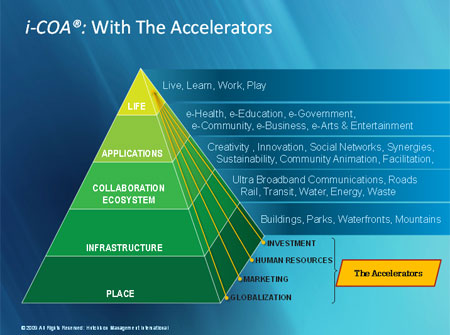
    Figure 2 adds the Accelerators. They have a big impact on the rate and nature of economic and social development of the community. Coincidentally, the communities that have won the Intelligent Community of the Year over the past 15 years have all implemented most of the elements of i-COA. More will be said of the characteristics and details of the various layers in i-COA in the coming weeks.

    i-COA - the Intelligent Community Open Architecture

    * ”i-COA” and “The Intelligent Community Open Architecture” are registered trademarks of Hutchison Management International.

  • Pondering visionary Jane Jacobs and Intelligent Communities

    Jane Jacobs had it right when she wrote her ground breaking 1961 book The Death and Life of Great American Cities. She lamented the many failed attempts at city planning by a host of planners from Ebenezer Howard and his English Garden Cities in the late 19th century through Le Corbusier’s Radiant Cities in the 1920’s.  Concepts from both of these planners and their many disciples continued through much of the 20th century.

    Jacobs’ primary concern was that cities are really living organisms and cannot be modeled or planned in just one or two dimensions, particularly from just an architectural or physical layout perspective.  I was struck by the correctness of her ideas when I compared many world cities to Dubai while visiting there to give a speech last November. My Dubai observations and feedback from friends and relatives who live there is that iconic architecture is interesting but it alone does not create a livable, “comfortable” city with practical neighborhoods. Much more is required.

    The issue is how to plan for the complete community, particularly with our new opportunities for “e-everything” including new forms of virtual collaboration and benefits from e-health and other social applications made possible by new ultra broadband infrastructures.

    Later this week I am speaking in New York at the annual conference of the Intelligent Community Forum,  www.intelligentcommunity.org where the Intelligent Community of the Year will also be announced from a list of the Final 7 that was selected in March.  Previous winners include Gangnam, South Korea, Taipei, Glasgow, Singapore and Waterloo, home of the Blackberry® in Canada.  At the ICF conference I will present  “i-COA®”, the Intelligent Community Open Architecture five layer model that I hope will provide a framework for all to use and develop as they move forward with their city planning.  Like the OSI Seven Layer Model for Telecommunications i-COA should evolve into a useful planning framework that would be approved by Jane Jacobs and others concerned with the need for an integrated approach to creating the 21st century intelligent cities of the future. I will describe i-COA in more detail in my next blog update.